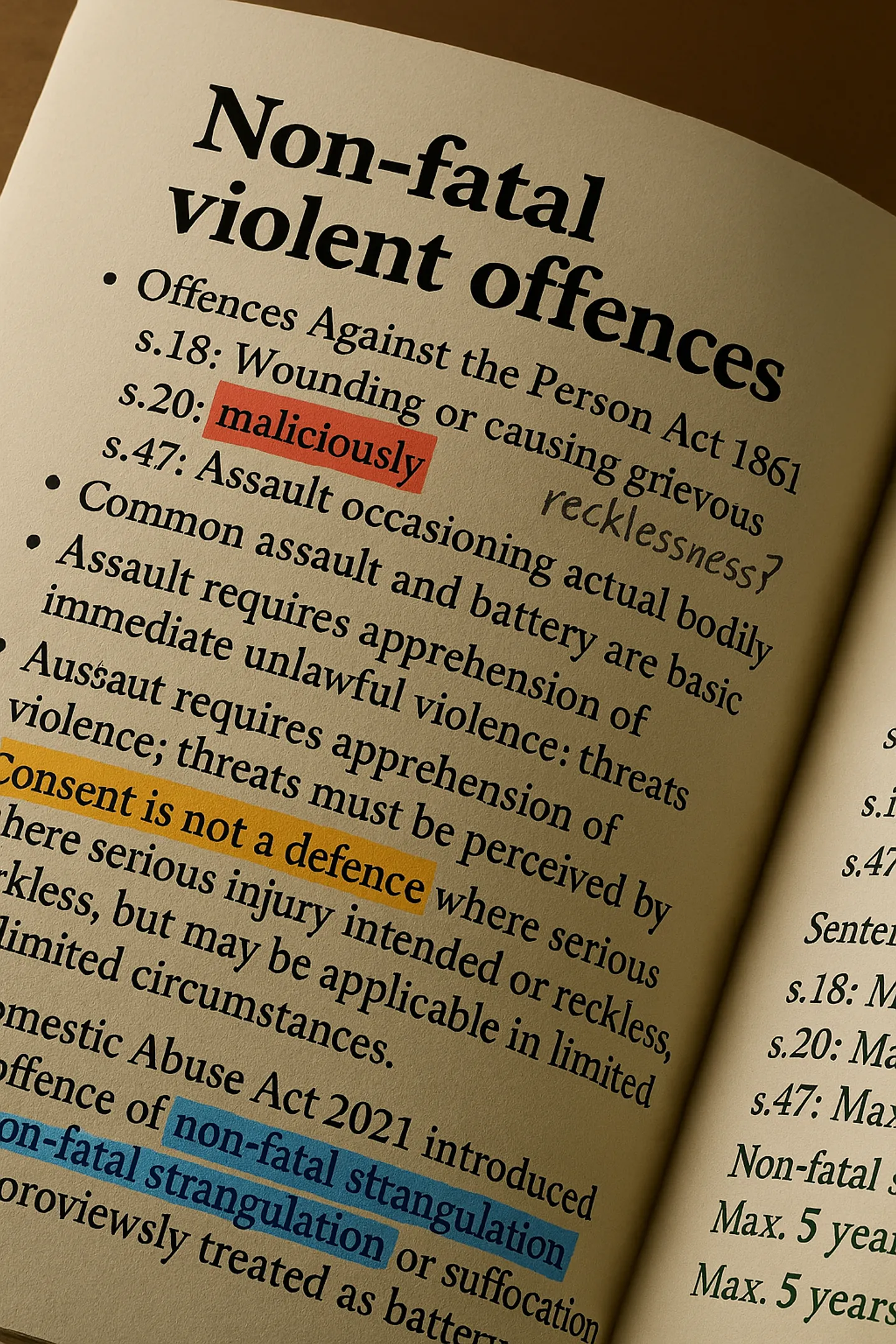
Non-fatal violent offences Defence barrister
Defend serious assault charges with conviction. Charlie commands GBH, ABH, and violent disorder trials. Expert at challenging medical evidence, dismantling CCTV interpretations, and securing not-guilty verdicts in high-pressure Crown Court battles.
Contact CharlieNon-Fatal Violent Offences – Expert Defence You Can Trust
Why Instruct Charlie Sherrard KC for Violent Offences Defence?
Allegations of violent offences can have devastating consequences for your liberty, career, and reputation. Charlie Sherrard KC is widely recognised as one of the UK’s leading barristers in serious assault and violent offences defence, offering unparalleled expertise across the full spectrum of non-fatal violent crimes.
Mastery of Grievous Bodily Harm (GBH) Cases
Charlie has defended countless Section 18 GBH with intent and Section 20 GBH cases, including those involving life-changing injuries, multiple complainants, and alleged gang-related violence. His deep understanding of the legal distinctions between these offences—particularly around intent and recklessness—enables him to identify crucial weaknesses in the prosecution case and construct powerful defence strategies.
Expertise in ABH and Common Assault Defence
From Actual Bodily Harm allegations involving domestic contexts to common assault charges arising from public order incidents, Charlie brings forensic attention to detail. He understands how seemingly minor evidential inconsistencies can undermine entire prosecutions, and has secured numerous acquittals by meticulously challenging witness reliability, police procedures, and prosecution assumptions.
Devastating Cross-Examination of Medical Experts
One of Charlie’s defining strengths is his ability to challenge medical and forensic evidence. Whether questioning causation in serious injury cases, exposing alternative explanations for injuries, or demonstrating that medical conclusions are speculative rather than definitive, Charlie’s cross-examination of expert witnesses is consistently described as “devastating” and “surgical” by instructing solicitors and judges alike.
Formidable Advocate in Self-Defence Cases
Self-defence cases require nuanced legal argument and compelling presentation of the defendant’s perspective. Charlie excels at demonstrating that force used was reasonable and necessary in the circumstances, particularly in cases involving genuine fear, protective instincts, or spontaneous reactions. His ability to humanise clients and contextualise their actions has resulted in numerous acquittals in cases where defendants faced serious charges.
Commanding Multi-Handed Violent Disorder and Affray Trials
In complex multi-defendant trials involving violent disorder, affray, or joint enterprise allegations, Charlie’s strategic thinking and courtroom command are invaluable. He identifies inconsistencies between co-defendants’ accounts, challenges blanket prosecution theories, and ensures individual culpability is properly assessed rather than assumed through association.
Expert CCTV and Digital Evidence Analysis
Modern assault prosecutions often hinge on CCTV footage, mobile phone evidence, and digital records. Charlie works closely with defence experts to challenge prosecution interpretations of video evidence, demonstrate alternative scenarios, and expose assumptions about identification, timing, and the sequence of events. His meticulous approach to visual evidence has proven decisive in numerous trials.
Notable Assault Defence Cases
Charlie Sherrard KC has been instructed in some of the most serious and high-profile violent offences cases heard in Crown Courts across England and Wales:
-
Successfully defended multiple Section 18 GBH with intent cases involving allegations of life-threatening injuries, including cases where medical evidence suggested grave harm but causation and intent were successfully challenged.
-
Secured acquittals in multi-handed violent disorder trials where clients faced allegations of participation in serious group violence, demonstrating individual lack of involvement through careful CCTV analysis and witness challenge.
-
Achieved not guilty verdicts by challenging causation in serious injury cases where medical experts initially attributed injuries to the defendant’s actions, but alternative explanations and evidential gaps were exposed through expert cross-examination.
-
Defended complex domestic abuse cases involving allegations of coercive control combined with assault charges, where relationship dynamics and context were crucial to establishing the truth.
-
Successfully represented defendants in knife crime cases involving possession of offensive weapons combined with assault allegations, achieving charge reductions and favourable outcomes through strategic negotiation and trial advocacy.
Areas of Expertise
Charlie Sherrard KC provides comprehensive defence representation across all categories of non-fatal violent offences:
Section 18 GBH – Grievous Bodily Harm with Intent
The most serious assault charge, carrying a maximum life sentence. Charlie has extensive experience defending allegations of intentional serious harm, including cases involving weapons, multiple injuries, and vulnerable victims. He understands the critical distinction between Section 18 and Section 20 offences and how intent must be proven beyond reasonable doubt.
Section 20 GBH/Wounding
Grievous bodily harm or wounding without specific intent. Charlie challenges both the severity of injuries and whether the defendant’s actions were reckless, often securing acquittals or charge reductions by demonstrating lack of foresight or self-defence.
Actual Bodily Harm (Section 47)
ABH cases frequently turn on medical interpretation of injuries and witness credibility. Charlie’s meticulous cross-examination exposes exaggeration, alternative causes of injury, and inconsistencies in complainant accounts.
Common Assault and Battery
Even seemingly minor assault allegations can have serious consequences. Charlie ensures proper scrutiny of evidence, challenges malicious complaints, and secures dismissals or acquittals where evidence is weak or unreliable.
Affray and Violent Disorder
Public order offences involving violence or threats. Charlie has defended numerous cases arising from nightclub incidents, football-related violence, and protest situations, often demonstrating that defendants were not participants or acted in self-defence.
Threats to Kill
These allegations require proof of genuine intent and serious threat. Charlie challenges whether words used constituted genuine threats, the context in which they were made, and whether complainants genuinely believed them.
Possession of Offensive Weapons
Including knives, knuckledusters, and other prohibited items. Charlie explores lawful reasons for possession, challenges whether items are offensive weapons, and negotiates strategic resolutions where appropriate.
Challenging Medical and Forensic Expert Evidence
Charlie works with leading defence medical experts to challenge prosecution medical opinions, expose alternative explanations for injuries, demonstrate that medical conclusions are not definitive, and undermine causation arguments.
Recognition and Testimonials
Charlie Sherrard KC is consistently recognised as a leading criminal silk in the most authoritative legal directories:
- Band 1 Crime Silk – Chambers UK Bar Guide
- Leading Silk in Crime – Legal 500
- Ranked Tier 1 for General Crime – Legal 500
Professional Praise:
“Charlie’s cross-examination of the medical expert was absolutely devastating. He exposed fundamental flaws in the causation evidence that the prosecution had relied upon entirely. The acquittal was a direct result of his brilliant advocacy.”
— Instructing Solicitor, Section 18 GBH Case
“He secures acquittals in apparently overwhelming cases through meticulous preparation and fearless courtroom advocacy. His ability to dismantle prosecution cases piece by piece is extraordinary.”
— Chambers UK Guide
“A class act with gravitas and charm who commands respect from judges and juries alike. His defence of serious assault cases is second to none.”
— Legal 500
“Charlie identified the fatal weakness in the prosecution case that everyone else had missed. His strategic thinking turned a near-certain conviction into a resounding acquittal.”
— Defence Solicitor, Multi-Handed Violent Disorder Trial
The Violent Offences Defence Difference
Sophisticated Self-Defence Strategy
Self-defence is a complete defence to assault charges if the force used was reasonable in the circumstances. Charlie understands how to present self-defence arguments compellingly, including:
- Demonstrating genuine and reasonable belief in the need to use force
- Contextualising the defendant’s perception of threat
- Establishing that the level of force was proportionate
- Challenging prosecution attempts to apply hindsight rather than assessing what the defendant reasonably believed in the moment
Challenging Injury Causation
Many assault prosecutions assume that because an injury occurred, the defendant caused it through unlawful violence. Charlie systematically challenges these assumptions by:
- Instructing defence medical experts to provide alternative explanations
- Exposing gaps in medical evidence and speculative conclusions
- Demonstrating that injuries could have pre-existed or resulted from other causes
- Challenging the prosecution’s burden to prove causation beyond reasonable doubt
CCTV Interpretation and Challenge
Video evidence is rarely as clear-cut as prosecutors suggest. Charlie’s approach includes:
- Detailed frame-by-frame analysis with defence experts
- Challenging identification where footage quality is poor
- Demonstrating alternative interpretations of actions and movements
- Exposing prosecution cherry-picking of footage to support their narrative
- Using footage to support defence accounts and undermine prosecution witnesses
Intent Disputes in Serious Assault Cases
The difference between Section 18 GBH (with intent) and Section 20 GBH (without specific intent) is crucial—it can mean the difference between a discretionary sentence and a mandatory minimum. Charlie meticulously challenges prosecution assertions about intent by:
- Examining the weapon used (if any) and the nature of force applied
- Analysing the context and what triggered the incident
- Demonstrating that actions were reckless rather than intentional
- Securing charge reductions or alternative verdicts where intent cannot be proven
Frequently Asked Questions About Non-Fatal Violent Offences
What is the difference between Section 18 and Section 20 GBH?
Section 20 GBH is grievous bodily harm or wounding where serious harm was caused but without specific intent—the prosecution need only prove you were reckless as to whether harm would be caused. The maximum sentence is five years’ imprisonment.
The distinction is critical. Charlie Sherrard KC has extensive experience demonstrating that intent cannot be proven, securing Section 20 verdicts instead of Section 18 convictions, or achieving complete acquittals.
What defences exist to assault charges?
- Self-defence: You used reasonable force to protect yourself from unlawful violence
- Defence of another: You used reasonable force to protect someone else
- Prevention of crime: You used reasonable force to prevent a crime or assist in arrest
- Consent: In limited circumstances, the complainant consented to the force (e.g., contact sports)
- Lawful chastisement: Parents may use reasonable force to discipline children (very limited)
- Mistaken identity: You were not the person who committed the assault
- Accident: The contact was not deliberate or reckless
- Lack of intent/recklessness: For more serious charges, the mental element cannot be proven
Charlie will carefully analyse all potential defences and construct the strongest possible case strategy.
What is self-defence and when does it apply?
- You genuinely believed you needed to use force to protect yourself (the belief must be honest, even if mistaken)
- The force you used was reasonable in the circumstances as you believed them to be
The key is that the jury assesses what you believed at the time—not what was objectively true, and not with the benefit of hindsight. You are permitted to use reasonable force even if you were mistaken about the threat, as long as your belief was genuine.
The force must be proportionate—you cannot use excessive force beyond what was necessary. However, the law recognises that people cannot be expected to calculate precise levels of force in the heat of the moment.
Charlie Sherrard KC excels at presenting self-defence cases, ensuring juries understand the defendant’s perspective and the reality of split-second decisions under threat.
Can I be convicted if I didn't cause the injuries?
Charlie frequently challenges causation in assault cases by:
- Instructing defence medical experts to provide alternative explanations for injuries
- Demonstrating that injuries could have pre-existed or been caused by other incidents
- Exposing weaknesses in medical evidence and speculative conclusions
- Showing that the prosecution cannot exclude other causes
In many cases, medical evidence is less definitive than prosecutors suggest. Charlie’s devastating cross-examination of medical experts has secured numerous acquittals where causation could not be proven.
What sentences do assault offences carry?
- Common assault: Maximum 6 months’ imprisonment (usually dealt with in magistrates’ court)
- ABH (Actual Bodily Harm): Maximum 5 years’ imprisonment
- Section 20 GBH: Maximum 5 years’ imprisonment
- Section 18 GBH: Maximum life imprisonment
- Affray: Maximum 3 years’ imprisonment
- Violent disorder: Maximum 5 years’ imprisonment
Actual sentences depend on aggravating factors (e.g., weapon used, vulnerable victim, group violence) and mitigating factors (e.g., provocation, lack of premeditation, genuine remorse). Previous convictions significantly increase sentences.
Charlie provides clear, realistic advice on sentencing and, where appropriate, constructs powerful mitigation to achieve the most lenient sentence possible.
What is joint enterprise in assault cases?
- You and others had a common purpose to commit an offence, and
- The assault was committed by one of your group in the course of that common purpose, and
- You foresaw that one of your group might commit the assault
This frequently arises in group violence situations—fights, violent disorder, or gang-related incidents. The prosecution may argue that everyone in a group is guilty of the worst violence committed by any member.
Charlie has extensive experience defending joint enterprise cases, demonstrating that:
- Clients had no common purpose with others
- Clients did not foresee violence might occur
- Clients withdrew before violence occurred
- The violence went fundamentally beyond what could have been foreseen
Recent Supreme Court decisions have narrowed joint enterprise law, and Charlie ensures these protections are fully utilised.
How do courts assess intent in assault cases?
- The nature of the weapon used (if any): A heavy or dangerous weapon may suggest intent to cause serious harm
- The part of the body targeted: Targeting the head, neck, or vital organs may indicate intent
- The force and repetition of blows: Multiple forceful blows suggest intent
- Your words before, during, or after: Threats or statements may indicate intent
- The relationship and history: Previous threats or violence may be relevant
- The context: Was it spontaneous or planned? Was there provocation?
Importantly, intent must be proven—it cannot simply be assumed because serious injuries resulted. Charlie meticulously challenges prosecution assertions about intent, demonstrating alternative explanations and ensuring that circumstantial evidence is properly scrutinised.
The difference between proving intent (Section 18 GBH) and proving recklessness (Section 20 GBH) is often the difference between a lengthy prison sentence and a community order or suspended sentence.
Can I argue I was defending another person?
The same legal principles apply:
- You must have genuinely believed that the other person was under threat (even if you were mistaken)
- The force you used must have been reasonable in the circumstances as you believed them to be
This defence frequently arises where someone intervenes to protect a friend, family member, or even a stranger from attack. Charlie has successfully defended numerous cases where defendants intervened to protect others, ensuring juries understand the genuine belief and reasonable force elements.
The law does not require you to stand by and watch someone else being attacked—you are entitled to use reasonable force to protect them.
Charlie Sherrard KC is recognised as a Band 1 Crime Silk by Chambers UK and a Leading Silk by Legal 500. He accepts instructions in all Crown Courts across England and Wales.